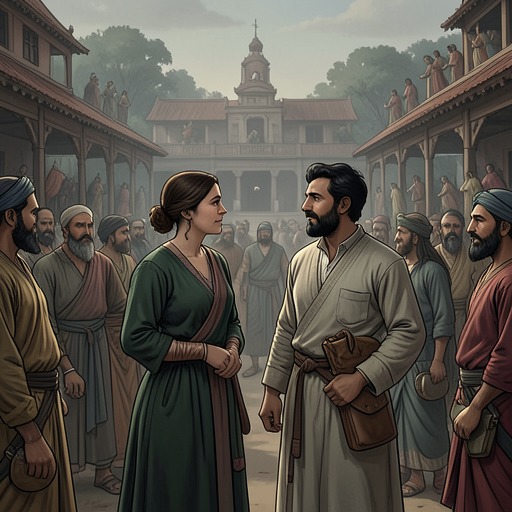
Ammu
The God of Small ThingsAmmu is a divorced mother of Estha and Rahel whose brief pursuit of love and freedom collides with the caste and gender rules governing her family and community. Denied education, trapped in an abusive marriage, and treated as having no rightful place in her parents’ home, she nevertheless forms a forbidden relationship with Velutha. The family’s effort to contain the resulting scandal and the police’s enforcement of caste order leave her isolated: expelled from home, separated from her children, and dead alone at thirty-one.
Identity and Background
Ammu’s early life is shaped by decisions made for her. After finishing school, she had to leave Delhi when Pappachi retired and moved the family to Ayemenem. He considered college an unnecessary expense for a girl, so Ammu was left to help with housework and wait for marriage proposals. With no suitable dowry, no proposals came; two years passed, including her eighteenth birthday. She grew desperate to escape her father and the home she shared with her bitter, long-suffering mother. Eventually Pappachi allowed her to spend a summer with a distant aunt in Calcutta, an opportunity that gave her a route out but did not secure lasting independence.
At twenty-seven, sitting beside Chacko in the Plymouth, Ammu carried the conviction that her life had already been lived: she believed she had received one chance and had made a mistake by marrying the wrong man. That sense of foreclosed possibility follows her into the later story. Marriage has not given her safety or a settled place in the world; divorce does not return either one.
Marriage, Motherhood, and Exile
Ammu’s husband’s violence followed a pattern: drunken attacks gave way to apologies and then pressure on her to help arrange his transfer. When the violence began to include the children, and the war with Pakistan began, she left him and returned to her parents in Ayemenem. She came back to the place she had once tried to escape, now with Estha and Rahel and, as the narrative puts it, no more dreams. Her return is not a reconciliation with home so much as a narrowing of her choices.
The children are central to Ammu’s life, but the narrative does not reduce her to maternal tenderness. She loves them; their vulnerability and their readiness to love people who do not love them in return can also exasperate her. In a later moment of rage and confinement, she shouts that they are the reason she is there and says she should have left them in an orphanage. She does not mean the words as a settled rejection, but Estha and Rahel are crouched outside the door and hear them. The episode exposes how pressure can turn her love into words that wound, leaving a consequence the children cannot simply dismiss.
Ammu’s status as a divorced daughter is itself a source of conflict. Baby Kochamma holds that a married daughter has no position in her parents’ home and that a divorced daughter has no position anywhere. She regards Ammu’s love marriage across community boundaries as especially outrageous. That judgment turns dependence on the family into a form of exclusion: Ammu is expected to live under its roof while being reminded that she does not belong there.
Desire and the Forbidden Relationship
Ammu’s character is marked by alternating tenderness and defiance. When songs she loves come on the radio, she sometimes withdraws from ordinary family life: she spends hours by the river with a small plastic transistor, smokes, swims at midnight, and seems to inhabit a space beyond the roles of mother and divorcee. The narrative links that restlessness to the contradiction within her—maternal tenderness alongside a fierce, potentially self-destructive anger. It also foreshadows her nighttime love for the man her children love by day, and her use of the boat they use in daylight.
The relationship with Velutha develops against the history of caste exclusion. Velutha is a Paravan, a community subject to restrictions on movement and contact; conversion to Christianity did not erase that stigma or bring equal access to public benefits. As a child, he had brought Ammu small handmade toys, calling her Ammukutty, or Little Ammu. Years later, their mutual recognition carries the weight of a social order that prescribes who may love whom, and how. When Ammu sees that Velutha understands what she feels, both look away; the narrative describes History returning to wrap them in the rules of love. Their private attachment is therefore both a personal choice and a challenge to a hierarchy with the power to punish it.
The narrative also places Ammu’s desire in contrast with the family’s acceptance of Chacko’s sexual access to women working at the factory. Mammachi and Baby Kochamma accept the idea of men’s needs and do not see a contradiction between Chacko’s Marxist politics and his feudal entitlement. Ammu, by contrast, is condemned for a relationship that crosses caste and family boundaries. This disparity makes clear that sexual conduct is not judged by one consistent standard: a man’s privilege is accommodated, while a divorced woman’s desire becomes a threat to the family’s reputation.
Accusation and the Machinery of Order
After Vellya Paapen reports the relationship, Baby Kochamma goes to the Kottayam police station and falsely represents Velutha as having tried to force himself on Ammu. She frames her account around the scandal and the family’s standing, and in telling it begins to believe it. The accusation replaces a consensual relationship with a story of assault, making Ammu’s own desire disappear from the version presented to the authorities.
Inspector Thomas Mathew later knows that Velutha had not seized what he took from the Touchable world but had been given it. When Ammu goes to the station after Sophie Mol’s funeral with the twins, hoping to correct the account, he deliberately humiliates and intimidates her rather than treating her as a credible witness. His action is not presented as an impulsive lapse: it is calculated to restore order in a world whose caste rules he believes have been breached.
The police response is reinforced by political calculation. Before acting against Velutha, the Inspector summons Comrade K. N. M. Pillai to learn whether Velutha has Communist protection. Pillai acknowledges knowing him but does not disclose his Party membership or his recent appeal for help, and he does not challenge the false accusation. The Inspector and Pillai, despite distrusting one another, cooperate through their separate positions within the same political reality. Ammu’s attempt to correct the record takes place inside this structure, where family reputation, caste hierarchy, and official authority converge against her.
Separation, Death, and Narrative Significance
Ammu’s exclusion culminates in her being made to pack her bags and leave after Chacko says she has destroyed enough already. She returns to Ayemenem with asthma and a rattling breath, a diminished figure whom Estha never sees in that state. The departure is not a private family disagreement alone: it follows the exposure of her relationship and confirms that the household will protect its reputation by removing her.
Ammu dies alone at thirty-one in a grimy room at the Bharat Lodge in Alleppey, where she has gone for a job interview as a secretary. The absence of her children gives the death its intimate force: there is no Estha at her back to talk with her, as in the childhood memory of the twins’ birthday present to her. She had once received a diary from Estha and Rahel, who wrote that they had bought it for her birthday, gave it with affection, and ended the celebration with a kiss. The later separation makes that small remembered scene a measure of what has been lost, not a promise of reunion.
Ammu’s life also reveals how the novel’s private and public histories interlock. Her family treats her as a threat to its good name; Baby Kochamma’s account and the police response turn that anxiety into official action; caste determines which relationship can be recognized and which person can be punished. The twins witness the resulting violence without initially understanding it, and the narrative describes what they see as a demonstration of human history pursuing ascendancy, structure, and monopoly. Ammu’s fate is thus not presented as the consequence of an isolated personal mistake. It is made by a social order that grants men latitude, denies a divorced woman a secure home, and converts the love between her and Velutha into an offense to be suppressed.